44 percent Asia: B2B credit sales overdue
Overdue invoices currently affect an average 44% of all B2B credit sales across the region.
Source: Atradius2025 · 8 Asian markets
The problem
In every market we checked, a large share of invoices is paid late, and the cost lands hardest on freelancers and small firms.
Nine sources, each linked, each with its year and region.
Sources checked:
Four regions, four different measures: credit sales, receivables and invoices. They are not comparable with each other, so each stands on its own.
Overdue invoices currently affect an average 44% of all B2B credit sales across the region.
Source: Atradius2025 · 8 Asian markets
Overdue invoices account for an average 23% of B2B receivables.
Source: Atradius2026 · US, Canada, Mexico
68.5% of invoices to small businesses were paid on time, within terms, so 31.5% were not. Large firms paying small suppliers.
Source: Govt of AustraliaAug 2026 · Australia
About one quarter of invoices are paid after the due date.
Source: Atradius2026 · Western Europe
Across the European Union, one invoice in two is not paid on time.
Source: European Commission2023 · EU-wide
71% of freelancers struggle to collect payment for work at least once in the course of their career. The survey behind the report covered over five thousand freelance workers.
Source: Freelancers Union2015 · United States
One in four bankruptcies is due to invoices not being paid on time.
Source: European Commission2023 · EU-wide
Nearly four in five companies in Western Europe report late payments. One in four reports losses of up to 5%.
Source: Atradius2026 · Western Europe
Businesses are owed an estimated £26 billion in late payments at any given time.
Source: UK Govt2025 · UK
The value of delayed payments owed to micro, small and medium enterprises has fallen to Rs 7.34 lakh crore as of March 2024.
Source: GAME / FISME / C2FOFigures as of March 2024 · India
At least 5 man-days are currently lost to chasing debtors, equal to € 8.74 billion for the entire EU economy. This is the value of time spent chasing, not an amount owed.
Source: European Commission2023 · EU-wide
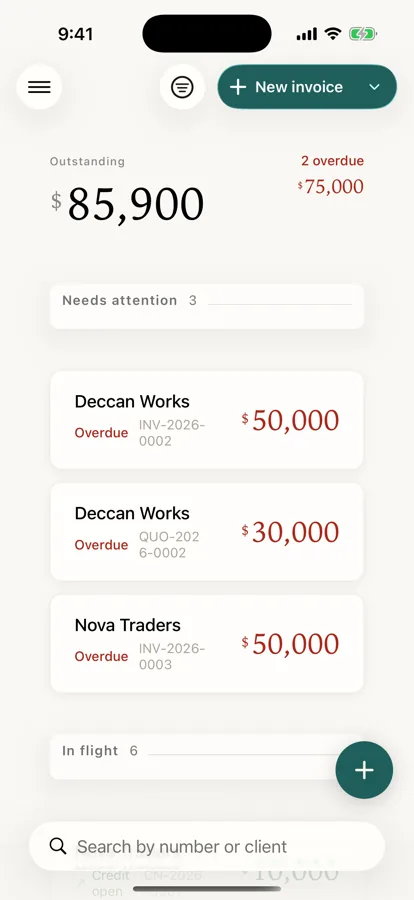
Chasing is the part Ochre can help with. Here is how.
Sources: Atradius (Asia, North America, Western Europe) · Payment Times Reporting Regulator · European Commission · Freelancers Union · Small Business Commissioner · GAME / FISME / C2FO
Ochre cannot make a client pay on time. What it does is make chasing easier:
Each quote is copied from the source as it read on 20 October 2026.
Overdue invoices currently affect an average 44% of all B2B credit sales across the region
Late payment remains a widespread challenge across the region, affecting seven in ten companies. Overdue invoices account for an average 23% of B2B receivables.
Paid on time (within terms) (%): 68.5
to reach 95 per cent of small business invoices paid, it took 55 days
The 31.5% on this page is 100 minus 68.5: our arithmetic, not a figure the Regulator prints.
about one quarter of invoices are paid after the due date
Over 500 invoices are issued every second in the EU.
1/2 is not paid on time
1/4 bankruptcies are due to invoices not being paid on time
at least 5 man-days currently lost to chasing debtors, equal to € 8.74 billion for the entire EU economy
This year, we surveyed over five thousand freelance workers across the United States to learn more about the nonpayment problem and shine a spotlight on the facts.
71% of freelancers struggle to collect payment for work at least once in the course of their career.
Nearly four in five companies report late payments with one in four reporting losses of up to 5%, a level that steadily erodes working capital and profitability.
Businesses are owed an estimated £26 billion in late payments at any given time
The value of delayed payments owed to Micro, Small and Medium Enterprises (MSMEs) has fallen to Rs 7.34 lakh crore as of March 2024, according to the Delayed Payments Report 3.0, “MSME’s Access to Finance and Timely Payments,” released by the Global Alliance for Mass Entrepreneurship (GAME), the Federation of Indian Micro and Small & Medium Enterprises (FISME), and C2FO.
These are separate studies, with different years (2015 to 2026), regions, bases (credit sales, receivables, invoices, money) and methods, so the figures are not added together or compared. A press release and a survey are not audits.